Touzil System
Free software to calculate Oxygen Drop, as well as Helium and Nitrogen growth, in pSCRs
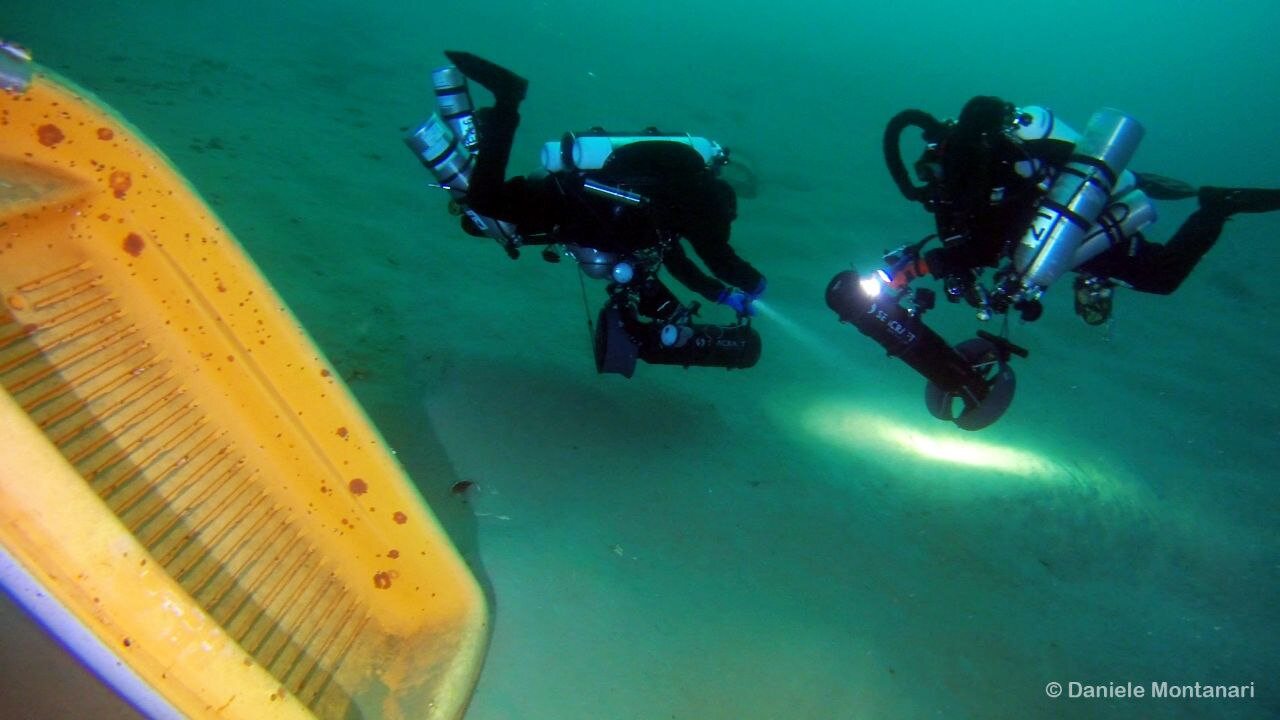
No registration required. For pSCRs only (what is a pSCR). Before using the calculator, please read the disclaimer at the bottom of this page.
What is a pSCR
A passive semi-closed rebreather (pSCR), also known as CMR or CVR (Constant Mass or Volume Ratio rebreather), recycles part of the exhaled gas. Its operation is completely mechanical and controlled by the diver's breathing, with no electrical or electronic parts. The counterlungs are two concentric bellows that move together: the exhaled gas fills the large inhalation counterlung and, through a non-return valve, the small exhaust counterlung. At the next inhalation the gas of the inhalation counterlung passes through the filter, which fixes the carbon dioxide, and returns to the mouthpiece; meanwhile the moving plate compresses the exhaust counterlung, whose gas is expelled into the water through the exhaust valve. The ratio between the two counterlungs, the Volume Ratio (most commonly 1:8 or 1:10), is the fraction of the ventilated gas expelled at each breath. When the volume in the loop has decreased enough, the plate opens the injector, which adds fresh gas from the cylinder: at constant depth, on average every 3 or 4 breaths.
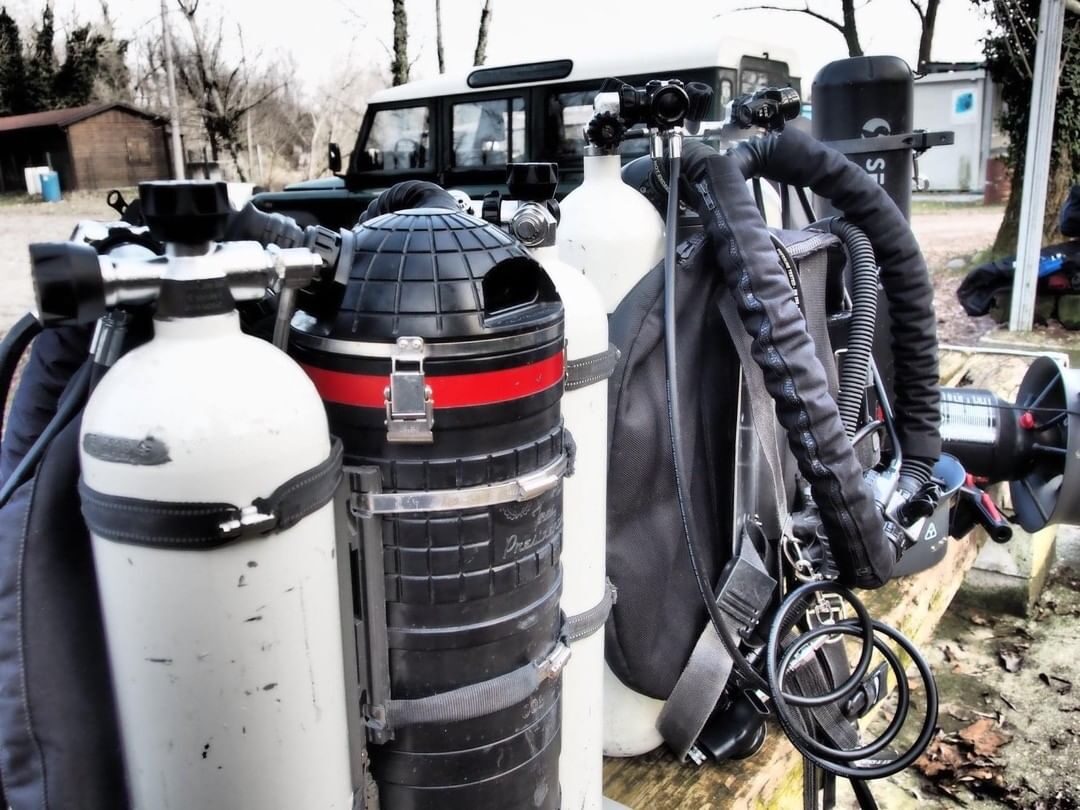
At each breath the diver metabolises oxygen and a fixed fraction of the gas is expelled. The injection fully restores the volume, but it replaces the metabolised oxygen with the supply mixture, which is not pure oxygen: the FO₂ in the loop therefore decreases until an equilibrium is reached, and stays lower than that of the mixture in the cylinder, while the fraction of inert gases, Helium and Nitrogen, increases. This is the Oxygen Drop. It depends on the diver's oxygen consumption and on the Volume Ratio, and it decreases as depth increases, because more gas is ventilated while the metabolised oxygen stays the same: it is largest in shallow water and during decompression. For the same reason, any mixture with an FO₂ below 50% becomes hypoxic if breathed with a pSCR at the surface. This is what the Touzil System calculates.
The Touzil System is only for pSCRs. Do not use it for closed-circuit rebreathers (CCR) or for active semi-closed rebreathers with constant mass flow: the results would be wrong and dangerous.
The Touzil System is free: no registration, no advertising, no tracking. It is developed and maintained in spare time, and donations help to keep it online and to improve it.

History of the project
Started in 2007, the Touzil System Project is a continuous effort to better understand Oxygen Drop in pSCR diving and to develop better and safer pSCR diving.
Notice that when diving a pSCR rebreather a reduction in inspired FO₂, oxygen percentage in the Mix, occurs on each breath until just a portion of fresh gas is injected and partially raises the Mix FO₂. This is referred as "Oxygen drop", which ends up reducing the Minimum Operating Depth of a given Mix, when compare to Open Circuit.
Oxygen Drop is one of the main risk factors in this unit type.
Oxygen Drop theory is paramount in the safety of pSCR diving, as the mechanics of rebreather diving affect gases properties. Furthermore the diver breathing efficiency and the real rebreather ratio plays key role in the true Oxygen Drop.
We developed the Touzil System, a proprietary software that can predict the Oxygen Drop and the consequent increase in the fraction of inert gases. The results provided by this software depend on the user and rebreather efficiency combinations. Both under workload and at rest. The density of the breathed mix is also calculated with an indication of whether the limits suggested by the Anthony and Mitchell studies have been exceeded.
This is the second version of the Touzil System; it is completely revamped and also adds the prediction of inert gas trends and scrubber life.
Versions
- 2.2 (November 2024): estimate of the scrubber life depending on the diver's consumption, brand and amount of absorbent used and whether it is a relaxing or strenuous dive.
- 2.3 (July 2025): calculation of the rule of thirds for obstructed environments. The software suggests the maximum amount of bars or litres that can be consumed with the pSCR in order to be able to go out in two breathing in open circuit. Do not engage obstructed environment without appropriate training.
- 2.4 (September 2025): greater usability with smartphones.
- 2.5 (May 2026): for bottom gases containing Helium, calculation of the recommended number of deco gases and of the control average at 6 metres as an additional safety check before the final ascent. Both values are derived from the effective Helium fraction actually breathed at the indicated depth, not from the nominal mix fraction.
- 2.6 (November 2026): free access, without registration. The calculations are unchanged.
Disclaimer
We recommend the application of PO₂ / FO₂ monitoring devices at least until full understanding of Oxygen Drop.
Prediction is challenging especially if the gas is changing during the dive, both in bottom and decompression phase, as it does on pSCR diving. Furthermore your average Open Circuit decompression rules will not mirror your rebreather needs, and could end up becoming inefficient for proper decompression. In fact DCS in not well trained pSCR rebreather divers is quite common. As of today decompression theory in general is still not a full understood science.
Get proper rebreather training. Don't just get the c-card, get someone that actually dive extensively the unit in your conditions. Also dive within your training limitations, a No Decompression Limit rebreather course is not intended to cover rebreather Trimix diving.
We took great care in developing and writing the software, but mistakes are always possible. In fact, they are always lurking. Therefore, we cannot take responsibility for any accidents or incidents that may occur when using this software. However, we would be grateful if you would point out any errors, oversights, inaccuracies and anything else that might limit the use of the Touzil System.
Touzil System v. 2.6, November 2026